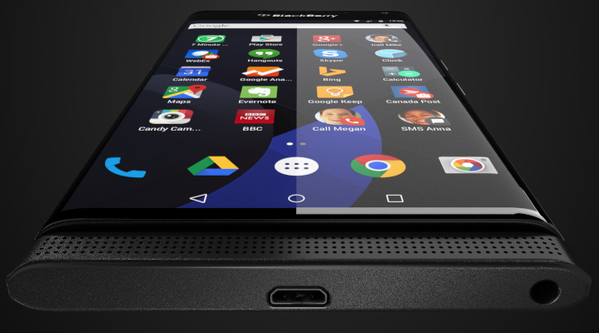

Rumors about Canadian BlackBerry producing an Android smartphone have appeared on the network since the end of last year. However, today (25), after several leaked images and a video-review, the company finally announced that it will release Priv, its first Android smartphone, later this year.

Known earlier as Venice, Priv carries a company trademark in its design: A qwerty physical keyboard. BlackBerry is known to target the corporate market and, with its products, enable its users to create and work with professional content wherever they are. For this, one of the visual identities of the company's devices is this physical keyboard.

In an announcement by John Chen, CEO of the company, the issue of data security of users was emphasized. According to Chen, the mission of the company is to ensure the privacy and productivity of customers, uniting the features of the Android system with the technology developed by the company.
Below you check a video made by the siteAndroid Authoritywith a Priv prototype.
[youtube https://www.youtube.com/watch?v=uJ6Yvp7-z3E&w=560&h=315]
Despite using Android on its new smartphone, BlackBerry stated that it will continue working on its own system, BlackBerry 10, and ensured that it continues to release updates for it. In addition, Priv will come from the factory with the BlackBerry Enterprise Service 12 app suite, which can also be manually downloaded by iOS and Windows Phone users.
In the announcement no hardware details of the device were revealed, but according to information circulating over the network, the Priv will have a screen of 5.4′′′ with resolution 1440 x 2560, quad-core processor 1.44 GHz, 3GB RAM memory and 128 GB internal memory, expandable with microSD card. The device should reach the end of the year in stores.
BlackBerry before Priv.
It is worth remembering that BlackBerry was once synonymous with the corporate market and owning a company apparatus was a sign of status and professionalism. However, with the accelerated evolution of iOS and Android, the company lost market quickly and today has only 0.5% of the world market for smartphones. Maybe adoption, even late, of Android, takes the company out of suffocation.


Leave a comment